VOLTS AND AMPS
Ohm's law
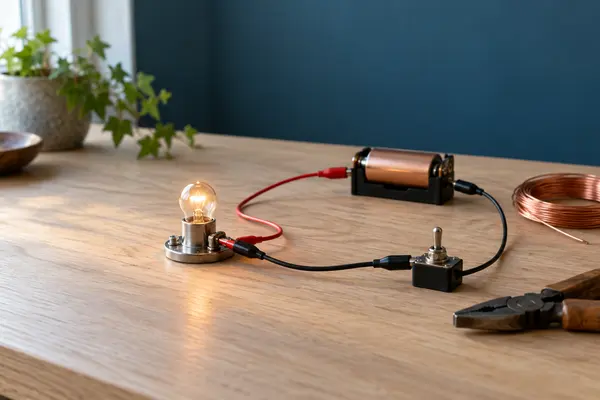
For most materials, current rises in step with voltage. Double the push, double the flow. One ohm is one volt per amp.
See a worked example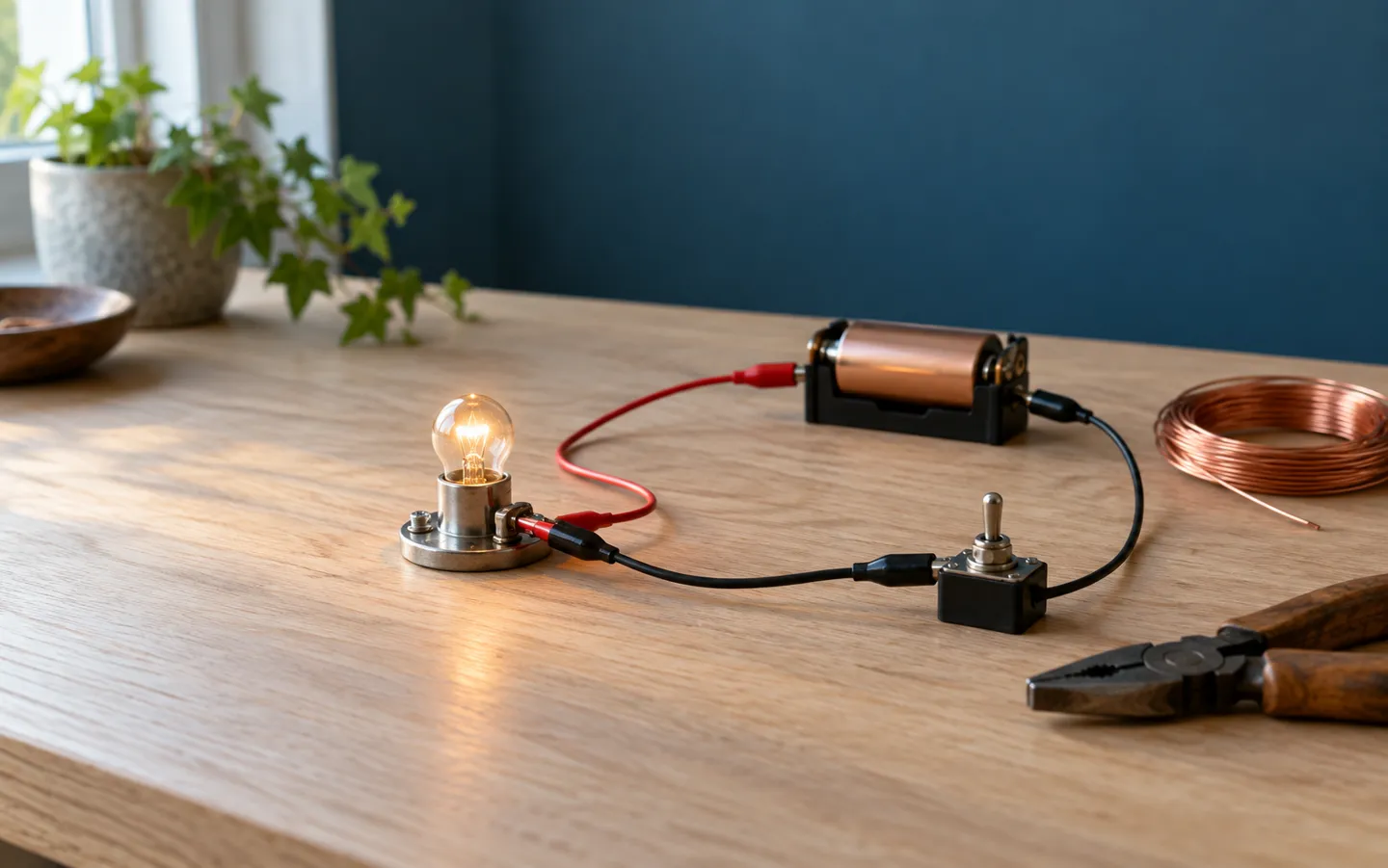
ELECTRICITY, EXPLAINED SIMPLY
I = V/R Ohm's law
AI-generated image, not a photograph of a real person or place.
Voltage pushes. Current flows. Resistance holds it back.
Every circuit, from a torch to a house, runs on the same three ideas and one short equation. Here is how they fit together, why your lights are wired in parallel, what UK mains really delivers, and why every plug has a fuse.
Educational only, with the sources linked.
THE BIG THREE
One equation links them:
current equals voltage divided by resistance.
VOLTS AND AMPS
For most materials, current rises in step with voltage. Double the push, double the flow. One ohm is one volt per amp.
See a worked exampleSERIES OR PARALLEL
In series, resistances add up and share the voltage. In parallel, each branch gets the full voltage.
Try the bulb labSAFETY BY DESIGN
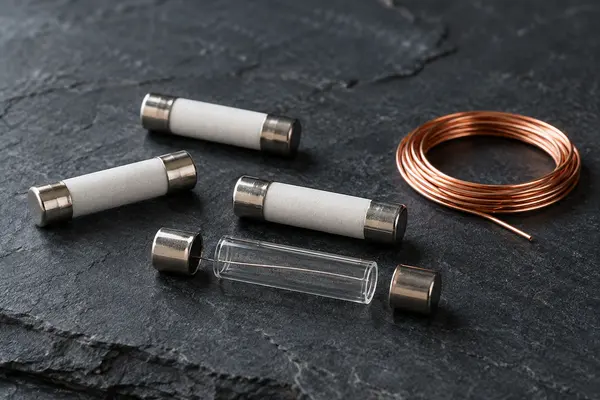
A fuse is a deliberately weak link that melts when too much current flows, before the wiring can overheat.
How a fuse works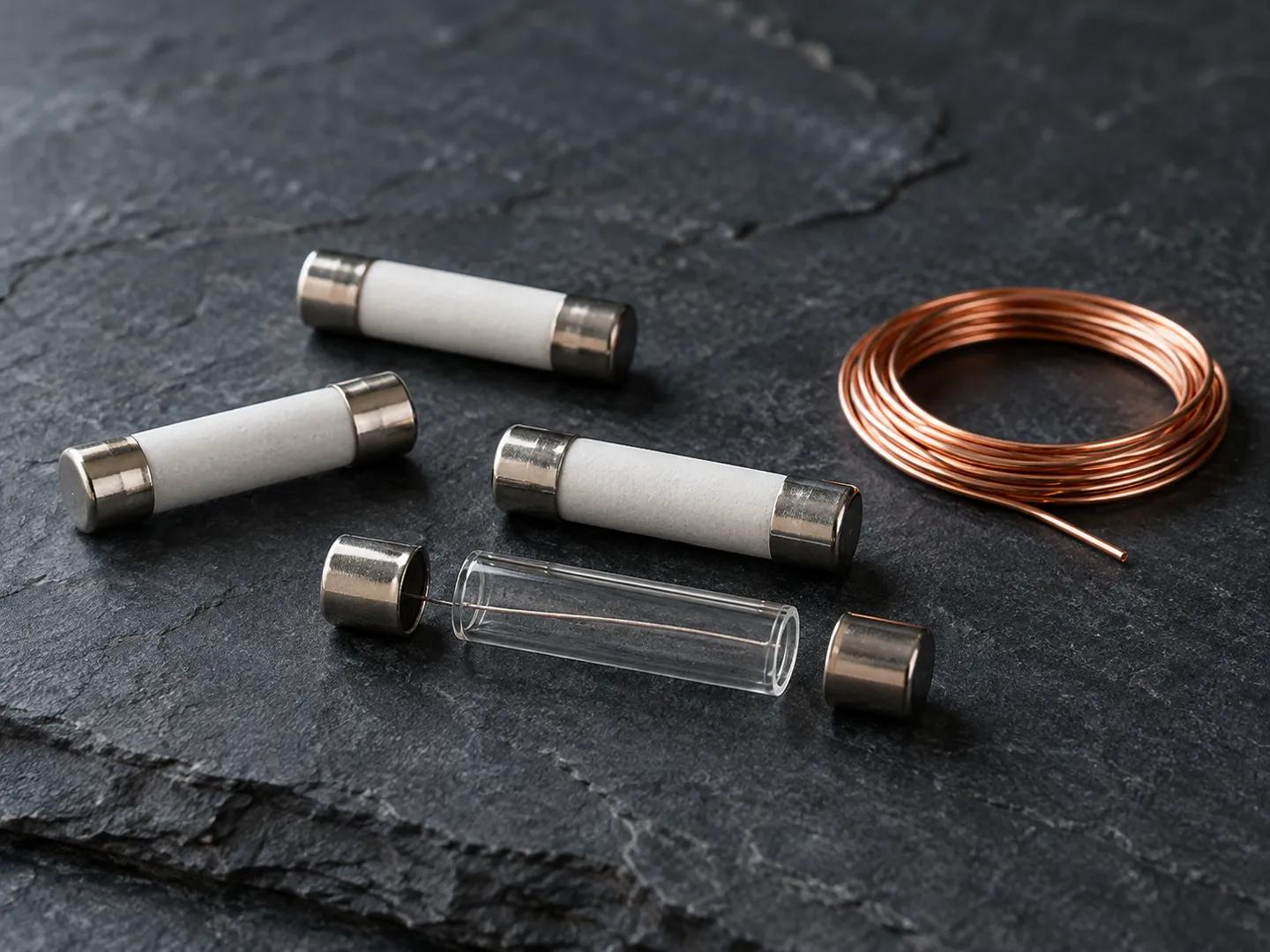
SPOT IT AT HOME
Switch off one lamp and the others stay at full brightness. That independence is what parallel circuits give you.
Appliances list their power in watts. Divide watts by volts and you get amps: a 2,300 W kettle on 230 V draws about 10 A.
A filament bulb has lower resistance when it is cold, so it briefly draws more current at the moment it is switched on than once it is hot and glowing.
Understanding circuits is not the same as working on them. Mains wiring is a job for a qualified electrician working to BS 7671.
SAME PARTS, DIFFERENT LAYOUT
A textbook example: 1 Ω, 6 Ω and 13 Ω
connected to the same 12-volt source.
20.0 Ω 0.600 A
Total resistance
The resistances simply add up. Only 0.6 amps flows, and the 12 volts is shared out: 0.6 V, 3.6 V and 7.8 V across the three resistors.
IN SERIES · ONE PATH
0.804 Ω 14.9 A
Total resistance
Each resistor gets the full 12 volts. The total resistance is lower than even the smallest resistor, so the source supplies about 25 times as much current.
IN PARALLEL · THREE PATHS
Heat
Too much current
Excess electric power turns into unwanted heat. A damaged cord or an overloaded circuit carrying too much current can overheat and even start a fire inside a wall.
THE PROBLEM
Open circuit
Fuses and circuit breakers
A fuse holds a metal strip with a low melting point that melts and permanently breaks the connection. A circuit breaker does the same job but can be reset.
THE FIX
Adding more paths lowers total resistance and raises total current. That is why plugging more and more appliances into one supply draws more current from it, and why circuits need protection.
THE BULB LAB
Imagine a 12-volt battery and some identical bulbs of 6 ohms each. Pick a layout and see how much current the battery has to supply, worked out with Ohm's law.
A simplified model: real bulbs change resistance as they heat up, so real figures differ. The pattern is what matters.

CIRCUIT FACTS
Georg Simon Ohm (1787–1854), a German physicist, was the first to show by experiment that the current in a metal wire is directly proportional to the voltage across it.
A car headlight drawing 2.50 amps from 12.0 volts has a resistance of 12.0 ÷ 2.50 = 4.80 ohms. When cold, its resistance is lower, so it draws more current at the moment it is switched on.
A metre of thick copper wire has roughly 0.00001 ohms of resistance. The ceramic insulators that hold up power lines have a million million ohms or more.
The law sets the declared low-voltage supply at 230 volts and 50 hertz. The voltage may run up to 10% above or 6% below (about 216–253 V); the frequency may vary by 1%.
Electrical installations in the UK follow BS 7671, the IET Wiring Regulations, which the Institution of Engineering and Technology co-publishes with the British Standards Institution.
QUICK QUESTIONS
Short answers to the questions people ask most.
Voltage is the push that drives electric charge around a circuit, measured in volts. Current is how much charge actually flows each second, measured in amperes (amps). Resistance, measured in ohms, is what holds the flow back.
For most materials the current is directly proportional to the voltage: double the push and you double the flow. Written as a formula, current equals voltage divided by resistance (I = V/R), and one ohm is one volt per ampere.
In a parallel circuit each device has its own path and receives the full voltage of the supply, so each one works independently. Switching off one lamp does not dim or switch off the others, which is how buildings are wired.
The declared low-voltage supply in Great Britain is 230 volts at 50 hertz. The law allows the voltage to be up to 10% above or 6% below that, roughly 216 V to 253 V, and the frequency to vary by 1% either way.
A fuse is a deliberately weak link: a strip of metal with a low melting point. If too much current flows for too long it overheats and melts, permanently breaking the circuit before the wiring can overheat. UK plugs must contain a fuse made to BS 1362.
Each figure on this page comes from the sources below.
A NAME WITH A SPARK
doodlecircuit.com is part of the DoodleSale portfolio. It isn't in an auction right now, but you can ask about leasing it.